
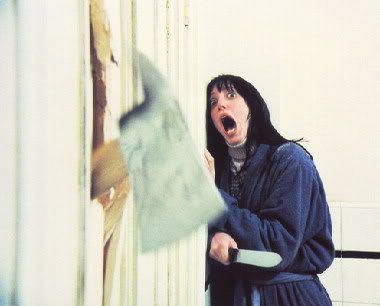
 Gender representation is very important in different genres, to identify the dominant roles that men and women are commonly cast in and also the type of film you are watching. Gender can be represented in many obviously different ways through different genres that immediately allow the audience to relate the role or behaviour of a particular character to a specific genre of film. For example in a romantic comedy the females will be presented as girly girls who are only interested in men and romance, but in a genre like horror the women are presented in a much different way with the exception of Annie and Lynda in Halloween. Throughout this essay I will be concentrating on how the different characters and genders in horror films are represented, through their roles and the narrative structure of the typical horror film. The three films that I will be focusing on during this investigation are 'Halloween' 1978, 'The Shining' 1982 and 'Eden Lake' 2008.
 In the horror genre, females are typically presented as being sex objects and victims, although 'The final girl' although a victim through the majority of the film, is an exception to this stereotype as she typically gets away. The final girl can be portrayed as a sex object but is more commonly portrayed as androgynous. This means that the lead female character is more masculine in behaviour and look than the other girls in the film, the tomboy character. The other female characters in the film are more sexual and are
The men in this genre are commonly portrayed as strong and dominant characters and are often associated with the killer, either by being the actual killer or working with them. On average they tend to outnumber women on the screen by two to one, although this research is old and may not be accurate for today’s horroWithin the media women are represented within four main categories: domestic, sexual, consumer and marital. Although these categories are relevant in all genres of film, the majority also fit well with the horror genre. Domestic women are portrayed as doing housework and stay at home housewives and mothers. Out of the three films I have studied, the female character that fits most into the domestic role would be Wendy out of 'The Shining'. She is a dedicated housewife and mother, and is seen going around the hotel in overalls doing housework and similar jobs. Laurie out of 'Halloween' can only be considered  domestic by her role of babysitting, and Jenny out of 'Eden Lake' can only be considered domestic to an extent, as she agrees to be someone’s wife, cooks and works closely with children, but we do not see her perform many domestic acts throughout the film, although it can be argued that she does not get a chance due to their surroundings. Marital is where the female character is either married or is linked to a man, with whom she plays the role of the wife, taking care of her family. This allows the women to be defined through her relationship with the man, so she is likely to be identified through the man rather than maintaining her own individual identity. The fact that when a couple gets married the women commonly takes the man’s last name, reinforces the idea that women lose their identify to men. This aspect also Wendy's character in 'The Shining' as she is married to Jack and doesn't really have her own identity except that of being Jacks wife and Danny’s mother. Jenny from 'Eden Lake' also fits this to an extent as she accepts an engagement ring off her boyfriend Steve. This is ironic as she accepts the ring when Steve is dying and therefore never gets the
 chance for her marital life to really even begin. Sexual is where women are objectified through the eyes of men, to be seen as a sex object more than an actual person. This is achieved through the male gaze, which is how the camera 'see's' women commonly through a male perspective. This applies to all of the three movies in which I have been studying, but some more than others. The main movie this category applies to would be 'Halloween'. The characters Judith, Lynda, Annie and Bob are the characters that are killed due to their sexual nature. The final girl Laurie isn’t sexualised and therefore isn’t killed in the film as the final girl is more commonly identified with rather than objectified. Jenny from 'Eden Lake' is sexualised in the fact that she has a sexual relationship with her boyfriend and then she ends up in a torn up
  dress, but this is as far as the male gaze goes in this movie as she is not really objectified. Wendy from 'The Shining' isn’t objectified at all as she is not attractive and there is nothing about her that makes girls want to be her or men want to be with her. The only minor character that is slightly objectified within this film would be the woman in the bathtub who is briefly objectified by Jack but doesn’t turn out to be what she originally seemed. Men are never objectified as the camera is always shown from the male point of view. The consumer category is the only category that doesn’t fit in with the characters within the horror genre, as you never see the characters shopping or doing any similar activities which you might do in different genres, such as romantic comedy.
 domestic by her role of babysitting, and Jenny out of 'Eden Lake' can only be considered domestic to an extent, as she agrees to be someone’s wife, cooks and works closely with children, but we do not see her perform many domestic acts throughout the film, although it can be argued that she does not get a chance due to their surroundings. Marital is where the female character is either married or is linked to a man, with whom she plays the role of the wife, taking care of her family. This allows the women to be defined through her relationship with the man, so she is likely to be identified through the man rather than maintaining her own individual identity. The fact that when a couple gets married the women commonly takes the man’s last name, reinforces the idea that women lose their identify to men. This aspect also Wendy's character in 'The Shining' as she is married to Jack and doesn't really have her own identity except that of being Jacks wife and Danny’s mother. Jenny from 'Eden Lake' also fits this to an extent as she accepts an engagement ring off her boyfriend Steve. This is ironic as she accepts the ring when Steve is dying and therefore never gets the
 chance for her marital life to really even begin. Sexual is where women are objectified through the eyes of men, to be seen as a sex object more than an actual person. This is achieved through the male gaze, which is how the camera 'see's' women commonly through a male perspective. This applies to all of the three movies in which I have been studying, but some more than others. The main movie this category applies to would be 'Halloween'. The characters Judith, Lynda, Annie and Bob are the characters that are killed due to their sexual nature. The final girl Laurie isn’t sexualised and therefore isn’t killed in the film as the final girl is more commonly identified with rather than objectified. Jenny from 'Eden Lake' is sexualised in the fact that she has a sexual relationship with her boyfriend and then she ends up in a torn up
  dress, but this is as far as the male gaze goes in this movie as she is not really objectified. Wendy from 'The Shining' isn’t objectified at all as she is not attractive and there is nothing about her that makes girls want to be her or men want to be with her. The only minor character that is slightly objectified within this film would be the woman in the bathtub who is briefly objectified by Jack but doesn’t turn out to be what she originally seemed. Men are never objectified as the camera is always shown from the male point of view. The consumer category is the only category that doesn’t fit in with the characters within the horror genre, as you never see the characters shopping or doing any similar activities which you might do in different genres, such as romantic comedy.
 Overall females in the narrative suffer a lot more within the horror genre then men do, as there is commonly more female deaths then males and in all three films the killer has been male. Halloween is a combination between being conservative and progressive, as it fits in with the typical stereotypes of the horror genre to an extent. It can be considered as progressive as there is a fairly equal mixture of men and women in the movie and the final girl Laurie is identified with rather than objectified. But on the other hand it can be seen as conservative as the majority of the women fit into at least one of the four categories in which I mentioned earlier. Also the male gaze at the beginning through Mike Myer's eyes objectifies his sister and there are more female deaths in the film then there are males. The majority of 'The Shining' is progressive as men outnumber women in the film by two to one, the lead female Wendy is not objectified and the percentage of female deaths is much higher than men. It can be considered conservative as the male gaze is used when objectifying the woman in the bath and that the three categories
of domestic, marital and sexual can be used to fit the characters in this film but at a stretch. In 'Eden Lake' the progressive factors are that, yet again there are many more men than women within the film. The majority of this film is conservative, as every category except consumer can be made to fit the female characters, as Jenny can be considered marital for excepting the engagement ring, she is sexualised to an extent and the domestic aspect would be at the beginning when the audience see her in her occupation which is the typical female job. The final girl is identified with rather than objectified which also fits in with the typical horror conventions.
To conclude how does the horror genre represent gender? Females are seen as the weaker sex, who are victims to men as sex objects and to the monster of the film. The final girl is usually the only girl character that survives or beats the monster due to her being androgynous, while she watches the other female characters get killed and overall punished for their sexual acts. The men are seen as being dominant, strong characters, and are how women are often identified while they being men maintain their own identities. Men usually outnumber women in horror by at least two to one and are normally linked to the monster by gender.


No comments:
Post a Comment